| Burgers (View) Various burgers |
Cajun Okra (View) Spicy Stew (Louisiana) |
Pancakes(View) Thick sweet pancakes (USA) |
| Shrimp Colombo(View) Slightly spicy dish (Caribbean) |
American cuisine is often associated with junk food and burgers, yet it is as diverse as many Western cuisines. Many recipes stem from the heritage of European immigrants (such as the hamburger, which originated in the German city of Hamburg) and then evolved with the new foods discovered by settlers: tomatoes, potatoes, squash, beans, corn, peanuts, chili peppers, cocoa, vanilla, pineapple, and even turkey.
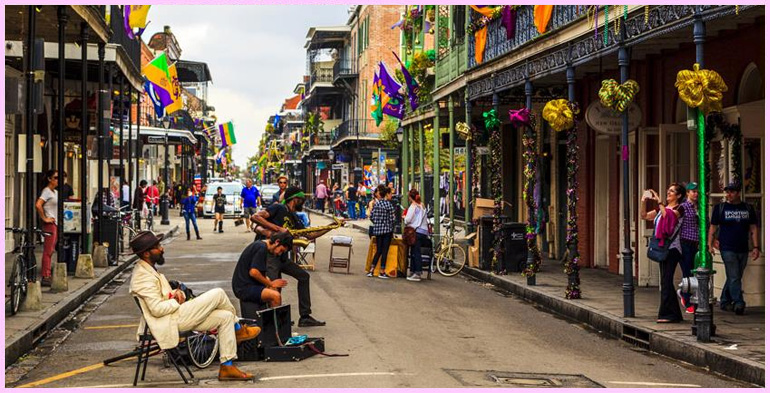
Louisiana is a state in the southern United States bordered by the Gulf of Mexico to the south. Texas is to the west, Mississippi to the east, and Arkansas to the north. Its capital is Baton Rouge, but its largest city is New Orleans. The state is named after the French explorer René-Robert Cavelier de La Salle, who named the Mississippi Delta region Louisiana in 1682 when he took possession of the area on behalf of King Louis XIV of France.
In the 18th century, the Louisiana Territory stretched from the Great Lakes to the Gulf of Mexico. It included much of what would become the midwestern United States, including ten present-day U.S. states (Arkansas, South Dakota, North Dakota, Iowa, Kansas, Missouri, Montana, Nebraska, Oklahoma, and present-day Louisiana) as well as portions of what would become Colorado, Wyoming, Minnesota, and Texas.
In 1762, following the defeat in the Seven Years' War, France ceded Louisiana to Spain by the Treaty of Fontainebleau. In 1768, the Creoles of Louisiana revolted and proclaimed a republic, called Free Louisiana. This republic lasted until 1769 and sent an embassy to Versailles in an attempt to obtain the aid of Louis XV, which was unsuccessful, as the latter did not even deign to grant it an audience. Louisiana was returned to France by Spain in 1800 as part of the Treaty of San Ildefonso. On May 3, 1803, the First Consul of the French Republic, Napoleon Bonaparte, sold Louisiana to the United States for $5 million plus $10 million for New Orleans, without the consent of the National Assembly. (The sale, illegal, violated the 1800 Treaty of San Ildefonso in several ways.)

Louisiana food is steeped in historical influences, including Cajun and Creole cuisines. Let's take a look at the differences between these two terms. We can go on and on about the nuances, but I'll give you THE difference: Creole cuisine uses tomatoes as a secondary ingredient, and true Cajun cuisine does not! This is how you can tell a Cajun gumbo or jambalaya from a Creole one. I say "secondary" because there are Cajun dishes, or sauces, that use tomatoes as a primary ingredient... but never a secondary one.
The word "Cajun" is the anglicization of the term "Cadien," which was used to describe French settlers arriving from Canada. They originally settled in the Acadia region of Canada, hence their name: "Acadians." With the British conquest of Acadia in the early 1700s, the Acadians were uprooted from their homes in what is known as the Great Upheaval. Many Acadians settled in Quebec, but some, believing that Quebec would become English, preferred to push farther south and ended up settling in the swampy region of Louisiana. Why the swamps? Because when they arrived, the territory was Spanish, and they accepted the refugees to settle, but only in the swamps, which did not interest them. In addition to its food, this rural region of Louisiana is famous for its music and its Cajun French language.
Seasoning is one of the most important parts of Cajun cooking, and it comes from more than just a generous dose of cayenne pepper. Most dishes begin with a blend of vegetables. The “Holy Trinity of Cajun cooking” uses onion, celery, and bell pepper to provide a flavorful base for many dishes. Garlic is never far away either. Paprika, thyme, bay leaf, parsley, green onions, and more are also favorites in Cajun cuisine.
The term "Creole" describes the population of people born to settlers in French colonial Louisiana, particularly New Orleans. In the 18th century, Creoles were the descendants of the French and Spanish upper class who ruled the city. Over the years, the term Creole expanded to include enslaved people of African descent as well as free people of color.
Just like the people, Creole food is a mixture of the different cultures of New Orleans, including Italian, Spanish, African, German, Caribbean, Native American, and Portuguese, to name a few. Creole food is considered more aristocratic than Cajun food. Creole food has more variety due to the Creoles' easier access to exotic ingredients (Don't forget that New Orleans is a huge port that quickly receives goods from all over the world) and the great mixture of cultures that contributed to a mixed cuisine. This is why, for example, you find tomatoes in Creole jambalaya but not in Cajun jambalaya (Tomatoes were quite rare. Not to mention that 3 centuries ago many people still thought that red tomatoes were inedible!)
