Carbonara is considered a Roman (Lazio) dish, although some claim it may have originated in Abruzzo. The ingredients and simplicity of the recipe connect it to the popular and pastoral cuisine of central Italy.
"Carbonara" could come from carbonaro, which means "coal burner" in Italian: it would therefore be the dish of workers working with charcoal. Another hypothesis is that the black pepper, abundant in the recipe, recalls coal dust.
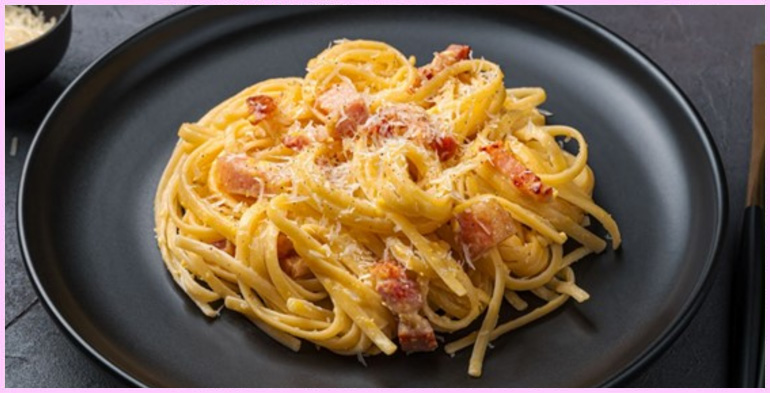
Traditionally, there's no cream, bacon, onions, or mushrooms—more recent additions popularized abroad (particularly in France and the United States). The Italian recipe relies on the natural creaminess achieved by emulsifying eggs with pasta starch and guanciale fat.
It's not so much that the recipe with crème fraîche is bad, it's just that it's silly to call it Carbonara instead of giving it a proper name! If you make the Chicken with Olives recipe but replace the chicken with veal, would you ever think to tell your guests that you cooked Chicken with Olives?!
Pasta: 200 grams. You should use pasta that holds the sauce well, so long, thin pasta, such as spaghetti n°5 or tagliatelle, is ideal. Its thinness allows it to be well coated in the egg-cheese mixture, without excess material.
Meat: 80-100 grams. Guanciale is ideal. The problem is finding it. You need a well-stocked Italian grocery store! It's a piece of unsmoked dried meat from the cheeks or jowls of the pig. Its name comes from guancia (“cheek” in Italian). Because it's dried meat, it keeps for a long time. Its flavor is very distinctive, so if you can get some, get some.
If you can't find it, buy an equivalent, knowing that it won't be exactly the same! Pancetta isn't normally smoked either and can be used as a substitute for guanciale when it's unavailable, but be aware that it's not the same fat. Avoid industrial bacon, however; it's better to cut it into cubes from pork belly!
Cheese: 30 grams of grated Pecorino Romano. Pecorino Romano is a traditional cheese from central Italy made from whole sheep's milk. As always, the ideal is to have a piece of grated cheese on hand when you need it; it's better than buying grated cheese (but again, it's not a disqualification if you only have grated cheese...).
30 grams of Parmesan.
3 eggs, pepper
Start by cutting the meat into small cubes, the size of industrial bacon or slightly larger. In a large bowl, combine 30g of grated Parmesan with 30g of grated Pecorino Romano. In another bowl, add two egg yolks and a third egg, a whole egg (yolk + white). Mix.
I'll give you the timing without the pasta; it's up to you to add the pasta according to its cooking time.
M-10: Place the meat in a sauté pan (without oil!) and place over medium heat.
M-4: Place the pan over high heat (This applies to Guanciale; if you're using other ingredients, you'll need to adjust the heat so as not to burn the meat but to melt a good amount of its fat.)
M-3: Add 4 cl of the pasta cooking water to the bowl of grated cheese and mix well with a tablespoon to form a cream. Stir in the eggs and mix well again.
M-1: Set the meat aside, reduce heat to low, drain the pasta, and place it in the sauté pan with the melted fat. Mix well, then continue stirring, adding the cheese until the pasta is well coated with the sauce. Add the meat, stir, season with pepper, and serve immediately.
