Originally known as lucanica, the first records of Italian sausage date back to the 5th century BC, when the Roman historian Marco Terenzio Varrone wrote: "Minced meat stuffed into a pig's intestine is called lucanica, because our soldiers learned from the Lucanians how to prepare it." The ancient writings of Cicero and Martial also mention Lucania as the birthplace of Italian sausage (Lucania is an ancient Roman district that roughly corresponds to present-day Basilicata, in the far south of Italy).
Over time, each region of Italy has evolved its preparation, and today Tuscan sausages are often cited as some of the best in Italy. Traditionally, selected pork is used, seasoned with salt, black pepper, and an aromatic herb, which in many variations is wild fennel, all stuffed into natural casings.
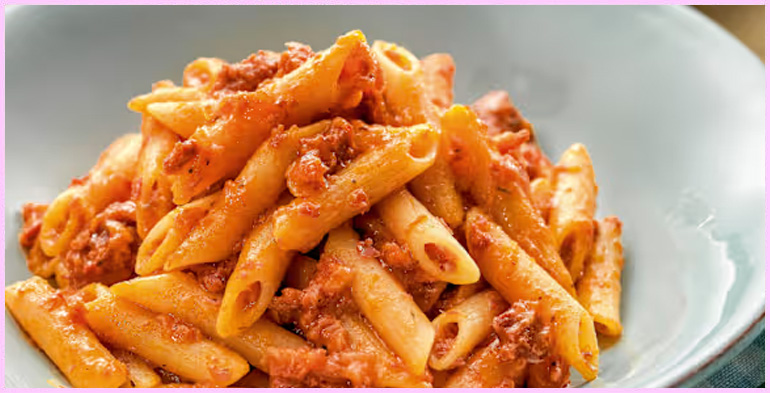
Pasta : 200 grams. I recommend Penne (tube-shaped with beveled ends) or Rigatoni (ribbed tubes a little larger than Penne with straight-cut ends), both quite similar to traditional Tuscan Chifferi.
Tomatoes: 200 Gr or 12 cherry tomatoes. You can perfectly work with canned tomato pulp (in this case I use the small 210g cans from Mutti). I said pulp, not tomato puree or concentrated tomato. The other option, which I prefer when I have some available, is fresh tomatoes. I use cherry tomatoes (also good quality, there's no mystery, if you use industrial tomatoes full of water, you won't get any flavor!) that I cut in half. Count 12 cherry tomatoes.
Meat: 300 grams of sausage. Ideally, you should have Tuscan Sausage. The problem is finding it. You need a well-stocked Italian grocery store! Otherwise, opt for high-quality sausage meat.
Fennel Seeds: If you don't have Tuscan sausages with fennel, you can add 2 grams of fennel seeds, it "does the job"!
White Wine: You will need 12 cl of white wine, ideally a white wine from central Italy, but other wines are suitable as long as they are good to drink...
Cheese: No cheese during the preparation, but grated Pecorino Romano that everyone can add to their plate as they wish. Pecorino Romano is a traditional cheese from central Italy made from whole sheep's milk. As always, the ideal is to have a piece of cheese that you can grate when you need it; it's better than buying grated cheese (But hey, again, it's not a disqualification if you only have grated cheese...)
Start the recipe 35 minutes before serving. I'm not talking about cooking the pasta since that depends on your pasta, so it's up to you to include heating the water and cooking the pasta in the timing. I cook on gas and for the pasta water, I heat a little water in the bottom of the pan and a liter and a half in the electric kettle. With this method, it takes me about 4 minutes to have boiling water in the pan.
M-35: In a sauté pan or large skillet, heat the olive oil. Roughly chop a small yellow onion, add it to the oil, and sauté until translucent. Meanwhile, slice the sausages lengthwise to extract the meat. Mix in the fennel seeds if necessary.
M-30: Add the crumbled sausage and let brown for 5 minutes - Prepare 12 cl of white wine.
M-25: Deglaze by pouring in 12cl of white wine.
M-20: Add the tomatoes. Reduce heat, cover and simmer, stirring occasionally.
Grate Pecorino Romano
M-1: Drain the pasta then add it, mix well for a minute then serve with Pecorino Romano on the side.
