Amaretto (short for the Italian "amaro," meaning "bitter") is a sweet alcoholic beverage (usually 28% ABV) with a slight bitter almond flavor. It originates from Italy, specifically the town of Saronno in Lombardy. Depending on the brand, it can be made from apricot kernels, bitter almonds, peach kernels, or almonds, all of which contain benzaldehyde, the source of the liqueur's almond flavor.
It can be consumed as an aperitif (with ice or in many cocktails) or as a digestif.
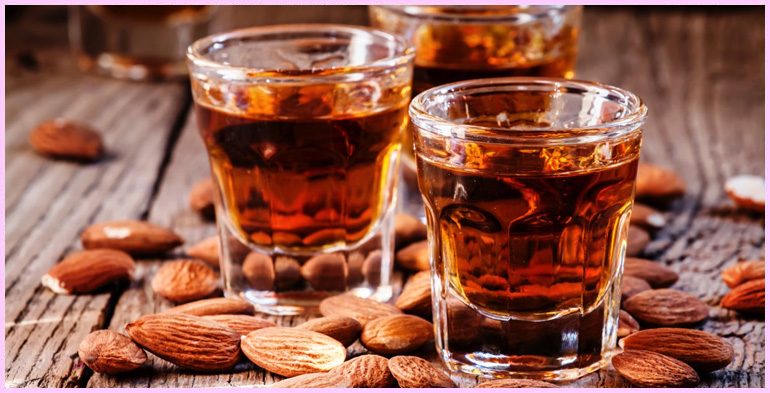
The most widespread legend tells that Amaretto was born in 1525. The painter Bernardino Luini, a student of Leonardo da Vinci, was invited to paint a fresco of the Madonna in the church of Saronno. He is said to have taken a young widow as a model, who, in gratitude, offered him a liqueur of his own making, made by macerating apricot kernels in alcohol, with herbs and spices: the ancestor of Amaretto.
Around 1900, the Reina family founded the company I.L.L.V.A. Saronno, which began marketing Amaretto under the name Disaronno Originale – one of the most famous brands in the world. Another notable brand is Lazzaroni, which bases its recipe on the maceration of real amaretti biscuits (small macaroons made from bitter almonds).
It can be drunk neat, at room temperature to fully appreciate its aromas, particularly the notes of bitter almond and vanilla, or "on the rocks" (with ice cubes) to tone down the sweetness while making the drink more refreshing. It can be enjoyed in a liqueur glass or an old-fashioned glass as a digestif after a meal or during a relaxing evening.
In cocktails, it can be enjoyed as an aperitif (Godfather with Bourbon, French Connection with Cognac, or Amareto Spritz...)
A shot of amaretto in a black coffee or espresso creates an almond coffee, perfect for winter.
Made by infusing almonds and alcohol, it is not distilled. The almonds are peeled and ground as finely as possible before being infused in alcohol for several weeks. Some herbs and spices may also be added to this infusion, such as cinnamon or coriander.
Amaretto is often made with apricot kernels, which impart a similar flavor.
