The fifth most consumed spirit in the world is Tequila, which represents a market of 14.5 billion USD (64 billion for Whisky, 26 billion for Vodka, 17 billion for Rum and 15 billion for Gin). For the sake of precision, I point out that I am not counting Baijiu, a rice alcohol whose market is 50% larger than that of Whisky but which is largely consumed only in China.
Tequila is an alcoholic beverage produced in Mexico from a plant called Agave (like Mezcal), more precisely the Blue Agave (Agave tequilana). To qualify as "Tequila," this beverage must be produced exclusively in the state of Jalisco or a few municipalities in the states of Nayarit, Michoacán, Guanajuato, and Tamaulipas.
Before the arrival of the Spanish, indigenous peoples (such as the Aztecs) already used agave to produce a fermented drink called pulque, made from agave sap. Pulque was consumed during religious rituals and had great spiritual significance.
The Spanish introduced distillation to Mexico, probably in the early 1500s. Lacking grapes to make brandy, they distilled fermented agave juice. This is how the first version of tequila was born, then called vino de mezcal.
The word "tequila" appeared in the 17th century, referring to the Tequila region (in the state of Jalisco). In 1795, José Antonio de Cuervo obtained an official license to produce tequila—this marked the beginning of the famous José Cuervo brand. Other families, such as the Sauzas, also played a key role in the industrialization of tequila in the 19th century.
In the early 20th century, tequila became popular throughout Mexico, particularly after the Mexican Revolution (1910–1920). It became associated with Mexican national identity, particularly after Prohibition in the United States (1920–1933), which encouraged the tequila trade across the border.
Tequila gained international popularity in the 1970s. In 1974, the Mexican government declared tequila a Designation of Origin (DOC): only drinks produced in certain regions of Mexico (particularly Jalisco) from blue agave (Agave tequilana Weber) could be called "tequila." Today, it is one of the most famous Mexican alcoholic beverages in the world.
Traditional tequila-making processes begin by cooking agaves to convert their starches into sugars. The hearts, or "piñas," are then crushed and shredded to release their juice. This liquid, called aguamiel, is then fermented and distilled twice. Some modern distilleries shorten this process. Instead, they throw uncooked shredded agaves into a machine that extracts the sugars with hot water. The process is very quick and efficient at extracting the sugars, but the resulting tequila lacks the complexity or flavor of a traditional agave spirit.
To be entitled to the name Tequila, the must that will be left to ferment and then distilled twice must be composed of at least 60% sugars from the juice of the Tequilana agave of the Azul (blue) variety, the remainder coming from other Agaves or much cheaper cane sugar. The law also authorizes the addition of edible caramel or almond essence, in order to accentuate the color. This leads to a first distinction between the noble Tequila which bears the name "100% Agave" and the others sometimes called mixed Tequilas.
There are four officially recognized types of Tequila:
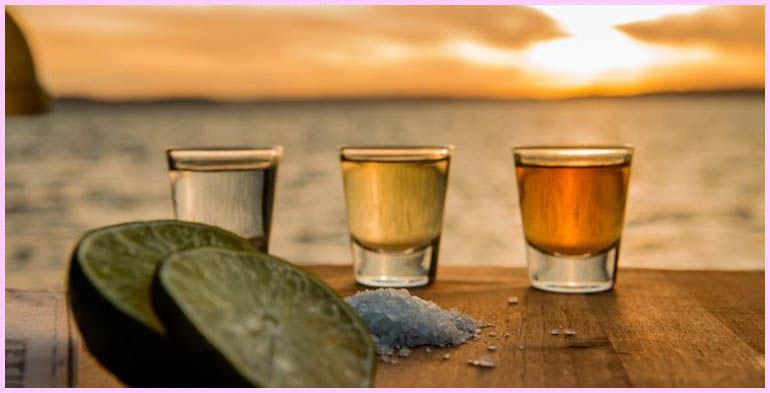
A myth popularized by 1940s movies: Tequila is traditionally consumed with salt and a slice of lime. This involves sprinkling the top of your left hand with salt and placing the lime between your thumb and forefinger. You lick the salt, drink the tequila shot in one gulp, and finish by possibly biting into the lime. This is a relatively modern way of doing things and by no means "THE" traditional method.
Mezcal (the name means "baked agave") is a Mexican alcoholic beverage made from the "maguey" agave plant. It is a spirit similar to tequila in origin but has some distinct characteristics that set it apart.
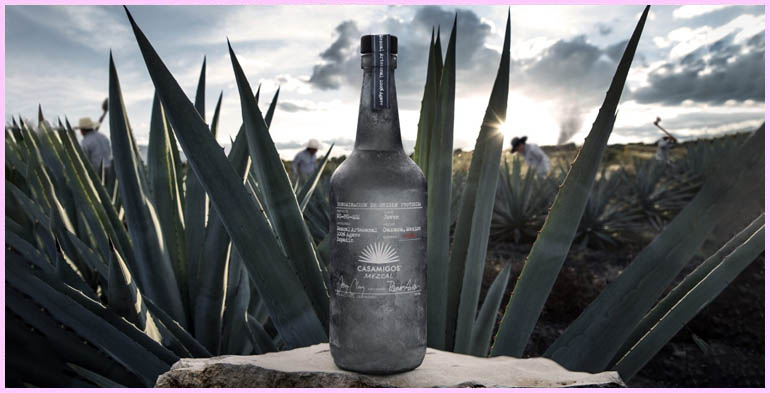
Some characteristics of Tequila are also found in Mezcal. The composition requires a minimum of 80% Agave Maguey to be entitled to the name Mezcal (the rest being much less expensive sugarcane alcohol) and so there are of course Mezcals that are distinguished by their designation "100% Agave Maguey". Another point in common with Tequila is the distinction by age since there are 'Joven' Mezcals that are bottled immediately after distillation, 'Reposado' that ages for at least two months in oak barrels and 'Añejo' that ages for at least one year in barrels.
The difference between tequila and mezcal comes from the way the agaves are cooked. Traditionally, the piñas for mezcal, which resemble giant pineapples that can weigh up to 35 kilograms, are cooked in palenques, conical pits 2 to 3 meters in diameter dug into the ground and whose walls are covered with hot stones, agave leaves, petate (palm fiber mats), and earth. Cooking is done by the heat of wood, usually oak, which is smoldering. This cooking lasts up to a week and transforms the starches naturally contained in the plant into sugars that will produce the alcohol. This slow cooking method also allows the drink to absorb the flavors of the earth and smoke, hence the very typical taste of mezcal.
Mezcal is often thought of as a kind of glass at the bottom of the bottle. It's important to know that this isn't traditional, but rather a marketing ploy to differentiate it from exported tequila dating back to the 1940s. And this worm isn't one! It's actually a caterpillar, a larva of a moth parasitic on the agave plant, Hypopta agavis. The larvae come from criaderos, that is, farms set aside for this purpose, separate from the plantations. There is therefore no link between the quality of a Mezcal and the presence or absence of a larva in the bottle.
I'll end with an excellent English-language site that gives reviews of a large number of mezcals, which helps you avoid ordering blindly. : https://www.mezcalreviews.com
