Port is a Portuguese fortified wine, produced only in the Alto Douro region, one hundred kilometers east of the city of Porto. The lower Douro River valley, near the city of Porto, is therefore not the domain of the wine bearing this name but that of 'vinho verde', the local climate not allowing the grapes to reach full maturity near the coast. For a long time, Port wine barrels had to be transported by boat [rabelos] to Vila Nova de Gaia, the industrial suburb of Porto, where the main Port sales companies are located. These boats are no longer in use today but can still be seen on the Douro.

Following an embargo proclaimed by Colbert, Louis XIV's prime minister, against the King of England, the English found themselves deprived of their favorite wine, Bordeaux "clairet." They then discovered wines of similar quality in Portugal. With the Methuen Treaty (1703), a treaty of military, diplomatic, and economic cooperation, they obtained the privilege of founding trading houses in Portugal in exchange for lower taxes on Portuguese wine. But Portuguese wine did not survive the journey well. It was then that an English merchant, John Beardsley, had the idea of increasing the alcohol content by adding pure wine brandy. This was the birth of Port in its current form, and it quickly became popular throughout Europe.
The United Kingdom is still one of the largest consumers of Port today, and the British have played an important role as owners of trading companies. This is why many of the great Port houses have English-sounding names, not Hispanic ones.
The production process begins with the harvest, carried out under particularly difficult conditions due to the vineyard's multiple terraces, accessible only on foot and in extremely hot weather. Grapes were also formerly crushed by foot in the lagares, the large natural granite vats still found in the most traditional quintas (wine estates) and still used for the fermentation of the best categories of Port.
During fermentation, a wine spirit, "brandy," with an alcohol content of 77% (approximately 100 liters of alcohol per 400 liters of wine), is added to the sweet must. The timing of this addition is crucial for the future of the Port: too early and the wine will be heavy and pasty; too late, it will lack fruit and roundness. Called "mutage," this operation has the advantage of stopping primary fermentation, preserving sugar in the wine [which gives it roundness and fruitiness] to prevent it from becoming too dry or too harsh; it also enhances its aging potential, giving it a more powerful body and a much richer bouquet. Once the mutage is complete, the wine enters a dormant period that lasts throughout the winter, allowing it to clarify under the action of the cold, thanks to successive rackings. When spring comes, the Port leaves the quintas, bound for the merchants' cellars. Depending on its quality, it will undergo a more or less lengthy aging process, in tuns (from 20,000 to 100,000 liters), in 550-liter barrels, in bottles, or using a mixed method.
All Port wines are divided into four main families: Ruby, Tawny, and White Ports, to which Rosés have recently been added. Tawny and Ruby Ports are made exclusively from red grape varieties, while White Ports are made from white grape varieties.
Ruby-type red Ports mature in the bottle. Thanks to their low oxidation, Ruby Ports retain their fruity aromas (blackberry and plum) and dark ruby color, highlighting the terroir in which they are produced. Sensitive to oxidation, they should therefore be drunk quickly once the bottle is opened. In ascending order of quality, the types of Ruby Port are as follows:
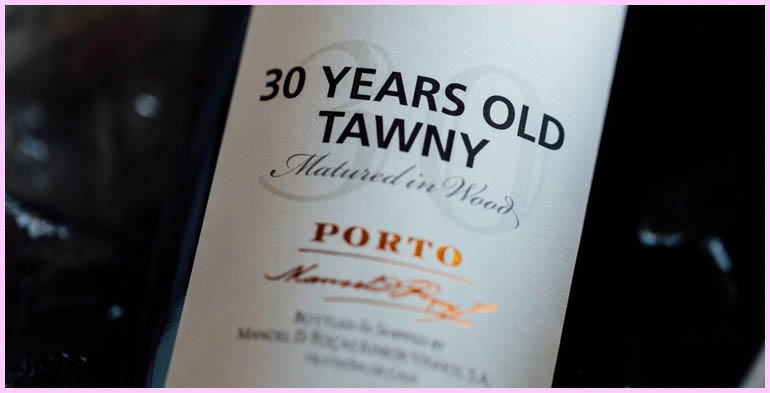
Typically, Tawny Port is a blend of vintages aged in barrels exposed to the air. The dark red color of Ruby Port gradually changes, as it matures, to lighter shades of brown, amber, and russet—called Tawny—due to oxidation. These Ports see their aromas evolve and also become more complex, with notes of dried fruit (walnuts and almonds) and wood (toast, coffee, and chocolate). This is a wine that must be drunk at room temperature to appreciate the richness of its aromas [Room = Reserved for a while in a room at room temperature, before being served]. These Ports can be kept for a long time once the bottle is uncorked. The Tawny Ports, in ascending order of quality, are as follows:
White Port is generally characterized by a rather oxidative aging process, with a long maceration period allowing the extraction of the compounds necessary to obtain the golden color and aromas. However, a shorter maceration period can be used to preserve the pallor and freshness of the aromas. It ages for varying lengths of time in large vats or wooden casks depending on the desired category of white: Classic White or Reserve White.
Colheita White or White with an Age Mark (10 years, 20 years, etc.) is aged in smaller barrels where oxidation plays its role. They are sometimes less alcoholic than other types of port and can be dry or sweet in six variants: extra-dry, dry, half-dry, half-sweet, sweet and Lagrima, this in relation to the quantity of residual sugars (Lagrima being the sweetest, they are best enjoyed alone or with blue cheese, foie gras, pâtés and sardines). All young white ports are excellent with seafood.
Rosé Port is made from the same grape varieties as Ruby (red). Its color results either from a very short maceration or direct pressing. The grapes are then pressed very slowly upon harvest to allow the juice to take on a slight color. Rosé Port, whose dominant fruitiness is marked by notes of cherry, raspberry, and strawberry, is best consumed young. Smooth and refreshing, it is best enjoyed very chilled (between 4 and 6°C), or even on the rocks, and can also be served in cocktails. The "rosé port" designation has been recognized since 2008 by the Douro and Port Wine Institute, but its production is marginal.
I still have a 20-year-old Taylor's Tawny, which remains my favorite but is quite difficult to find locally. Taylor's Ports are a sure bet; I occasionally have a white or a ruby from the brand. I also sometimes have a 20-year-old Vallado Tawny, which is also delicious.
