It is generally ignored, but in the Roman world there existed festive practices of cross-dressing (in the narrow sense of wearing clothes associated with the opposite sex to one's own). These practices were only valid in the sense of feminization, of a man disguised as a woman.
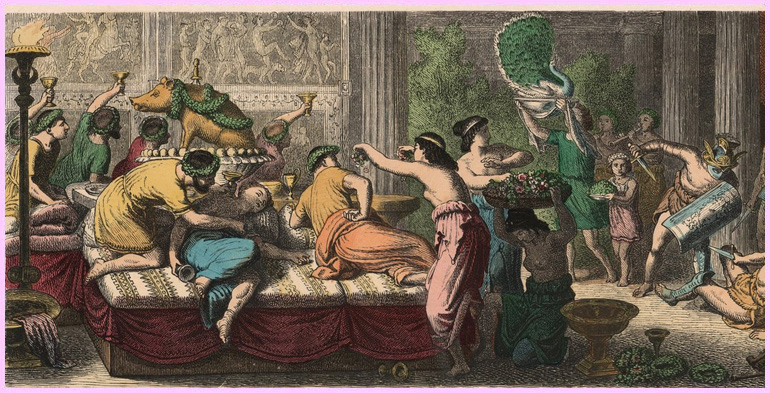
One example is the case of the flute players, who a week before the summer solstice would spread through the streets of Rome in women's clothing, or another Roman ritual involving masquerade and disguises, the Navigium Isidis (Ship of Isis), in honor of the great Egyptian goddess, whose mystery cult had reached Rome at the beginning of the 1st century BC, and was then favored in the following century by the emperors, Caligula in particular. This celebration took place on March 5 to officially mark the resumption of navigation at the end of the bad season (mare clausum). The Isiac procession is described by Apuleius in his Metamorphoses (book 11, chap. 8-9), who mentions in front of the solemn procession itself “groups in very agreeable costume, according to the inspiration and taste of each”, among which were men dressed as soldiers, hunters, gladiators, magistrates, philosophers, fowler and fishermen, or even wearing “golden boots, a silk robe, precious finery”, and whose “false hair…, undulating gait… simulated a woman” (feminam mentiebatur).
Cross-dressing also plays an important role in a major festival that appeared at the end of Roman Antiquity, the festival of the Kalends in January. It takes place on the first of the year and celebrates the renewal of time. Throughout the Roman world, but with a predominance, it seems, in its western part, New Year's celebrations are marked by noisy, disguised processions. However, these are not simply masks corresponding to theatrical roles or frightening figures to ward off the fear of death. The masks and disguises represent either gods (Jupiter, Saturn, Hercules, Venus, and Diana), or wild animals (most often, the deer), or women (outrageously made up). They therefore clearly express the desire to be other, to abolish the boundaries between human/divine, human/animal, and man/woman. They signify, according to Michel Meslin, who has studied this festival in particular, the “surpassing of oneself, in the momentary denial of one’s physiological, psychological, social condition, and in the violent desire to thus affirm a power and an energy to live and to be someone else”.
Le travestissement tient aussi une place importante dans une grande fête qui apparaît à la fin de l’Antiquité romaine, la fête des kalendes de janvier. Elle se déroule le 1er de l’an et célèbre le renouvellement du temps. Sur toute l’étendue du monde romain mais avec une prédominance semble-t-il dans sa partie occidentale, les fêtes du Nouvel An sont marquées par des cortèges déguisés et bruyants. Or il ne s’agit pas simplement de masques correspondant à des rôles de théâtre ou à des figures effrayantes pour conjurer l’angoisse de la mort. Les masques et déguisements représentent soit des dieux (Jupiter, Saturne, Hercule, Vénus et Diane), soit des animaux sauvages (le plus souvent, le cerf), soit des femmes (outrageusement fardées). Ils expriment donc clairement la volonté d’être autre, d’abolir les frontières humain/divin, humain/animal et homme/femme. Ils signifient, selon Michel Meslin qui a tout particulièrement étudié cette fête, le “dépassement de soi-même, dans le reniement momentané de sa condition physiologique, psychologique, sociale, et dans le violent désir d’affirmer ainsi une puissance et une énergie à vivre et à être quelqu’un d’autre”.
Many accounts by Latin authors such as Caesarius of Arles, Peter Chrysologus, Isidore of Seville and Boniface agree in describing a soldiery displaying flashy jewelry, outrageous makeup and offering themselves up to deceptive embraces: it is clear that these men imitate “the garrison whores” in their appearance and behavior.
This claimed sexual confusion attests to the desire to both realize the fantasy of primitive hermaphroditism, to benefit from the powers and prerogatives of the other sex, and to rediscover the vital energy of the original chaos. Such masquerades are not only a matter of collective release but also of a ritual act of passage, as well as of the “magical operation of capturing an energy that is normally foreign and forbidden”.
