The Caipirinha is an iconic Brazilian cocktail, known for its freshness and simplicity.
Sweet yet balanced, with a pronounced acidity (due to the lime), it's a very refreshing cocktail, ideal for hot weather.
The Caipirinha is a Short Drink (small quantity, high in alcohol, served without ice) and a Sour (alcohol + acid + sweet, in this case, Cane Sugar Syrup). It is one of the official cocktails of the IBA (International Bartenders Association).
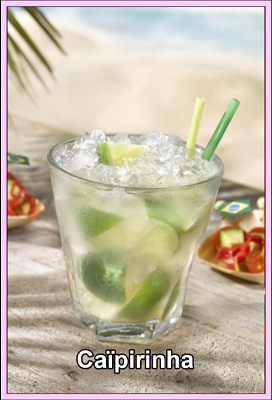 |
Classic recipePour 2 cl of fresh lime juice and 1 to 2 cl of cane sugar syrup (depending on the consumer's taste for sweetness) into an old-fashioned glass. Add a large portion of crushed ice, then 6 cl of cachaça and mix a little. Fruity RecipeYou can freely modify the taste of the Cocktail by going from 6 to 5 Cl of Cachaça and adding 1 Cl of Crème de fruit. |
The history of Cachaça, Brazil's national spirit, is closely linked to the country's colonial history and sugar economy.
The Portuguese introduced sugarcane cultivation to Brazil shortly after colonization in 1500. The first traces of fermented cane juice distillation appear between 1530 and 1550 in sugar mills (called engenhos). It was during this period that cachaça was born. The distillation technique is believed to have been imported from Africa or Portuguese Atlantic islands (such as Madeira or the Azores), where cane-based spirits were already being produced.
Cachaça was originally consumed primarily by African slaves on plantations, as a by-product of refined sugar. Gradually, it spread to all social classes, becoming a distinctly Brazilian drink.
In the 17th century, cachaça became a source of economic conflict with Portugal, which wanted to impose the sale of European spirits. In 1635, it was even banned, but this ban was largely ignored and then lifted in 1661.
In 2013, the United States officially recognized cachaça as a Brazilian beverage distinct from rum, strengthening its image in international markets. Cachaça is characterized by its waxy sweetness and a toasty aroma.
The name "Caipirinha" comes from the Portuguese word "caipira," which means a person from the countryside (equivalent to "peasant" or "country dweller"), and the suffix "-inha," which is an affectionate diminutive. So, "caipirinha" literally means "little country girl."
According to some sources, the caipirinha was invented in the state of São Paulo around 1918 as a cure for the Spanish flu. The original blend included cachaça, lime, garlic, and honey. It was believed that the drink boosted the immune system. Soon, lemon and sugar replaced the garlic and honey, making the drink more palatable—and ushering in the modern version.
In the 1950s and 1970s, with the rise of tourism, it became popular on beaches, particularly in Rio de Janeiro. In the 1990s and 2000s, the cocktail gained international notoriety with the rise of cocktail bar culture.
