Pony Play is primarily based on a training concept. And as with any training, the beginnings can be complicated. It is not enough to have intellectually understood what it is to 'play' the Pony, you still have to experience it concretely to fully understand all the implications. Indeed, it is not an animal role-playing game where you play the role of an animal, it is indeed a human, REDUCED to the status of an animal, who is going to be trained. The nuance is important. For example, the Pony is not allowed to speak BUT he understands perfectly what humans say to him (whereas if he played the role of a real animal, he would not be expected to understand a conversation).
The first phase of training is called breaking in. It allows you to test the activity before investing, or not, in making a parade harness. The harness is very important in Pony Play because there is a very important aesthetic dimension, hence the frequent use of ostrich feathers and various jewelry to embellish the harness which must highlight the Pony.
Objective |
The concept of breaking in consists first of all in verifying that the future Pony has understood the basic rules arising from its status. In fact, the Pony accepts to have the status of an animal and no longer of a human. It therefore remains protected, like any animal, against sadistic mistreatment but loses certain rights specific to humans. |
| . | |
Sessions |
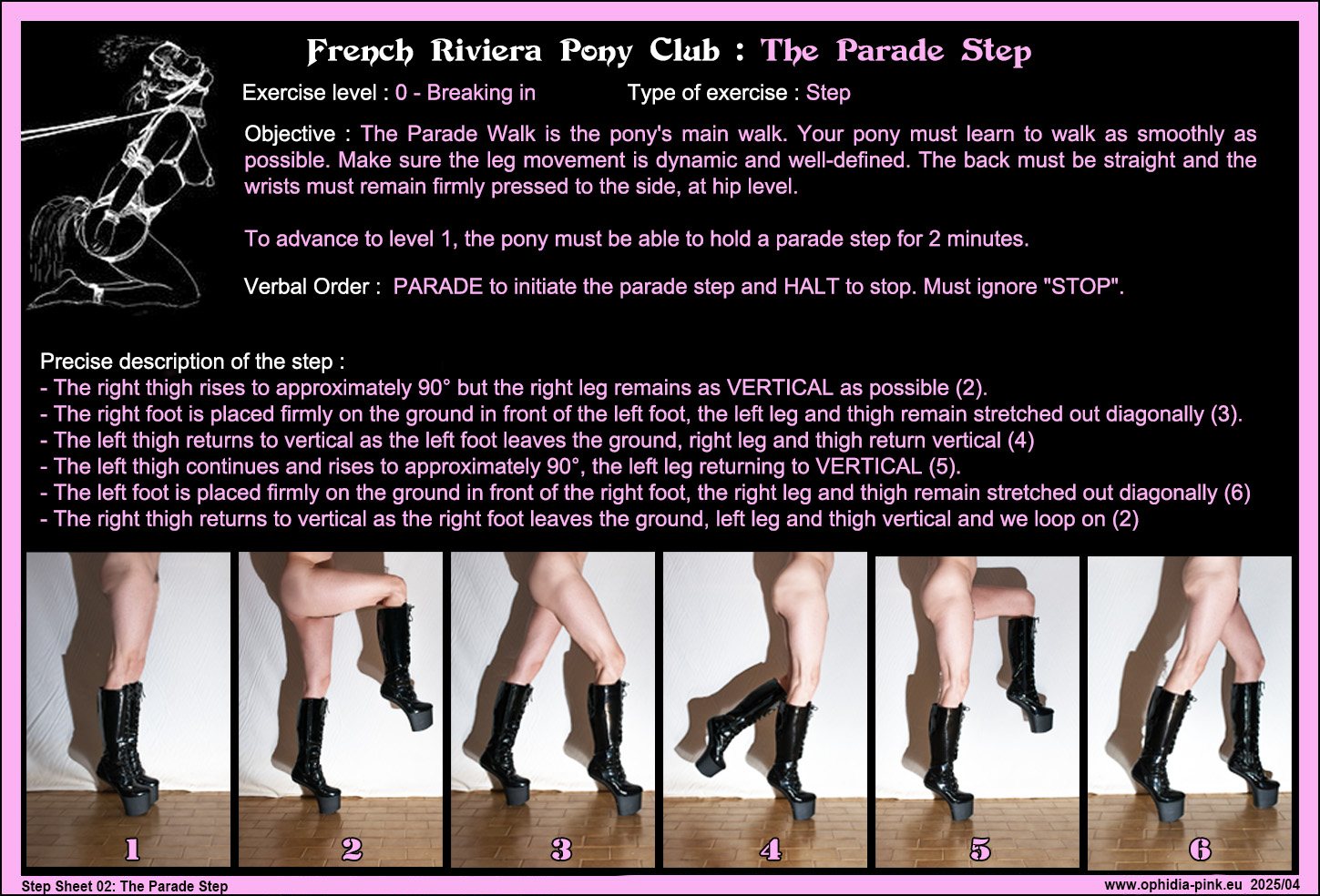
The breaking-in work is done through sessions lasting an average of 25 minutes (Some so-called "waking-up" sessions are a little shorter, 15 minutes, others can be longer if necessary, it is the trainer who remains the sole judge. These sessions take place as follows: After having cleared everything that was on the track (which should preferably form a loop even if a half turn at the end of the corridor remains an option, for lack of anything better), the Pony presents himself in outfit at the starting point. By "in outfit", we mean completely naked except for two bracelets on the wrists connected by a chain passing behind the back to ensure a straight back, shoulders well back, and a gag to prevent talking (It can be a bit (rubber bit, never metal!) if you have one but a ball gag or a scarf will do the trick. For aesthetic reasons, it is accepted from the breaking in that the Pony can wear a wig, generally very long and a headband in the shape of ears. Furthermore, depending on the temperature, it is perfectly acceptable for the pony to wear light shoes and a poncho or a blanket tied over the shoulders since this type of protection exists for equines. The trainer can conduct the session live or play a recording. In both cases, the Pony stands still at the starting point while waiting for the first command. It will then follow the training program until the end without interruption (unless there is pain or a serious problem, of course). The breaking-in session includes the following commands, repeated many times in a random order. WALK: The Walking Walk is a semi-resting exercise (it is the least tiring step) and it is also with this step that the Pony begins its session, as a form of warm-up during which the trainer will remind it of all the rules. The Pony must learn to have the most regular step possible, with a dynamic and well-marked leg movement. The back must be straight. If the Pony was stopped when it receives this order, it always begins walking with the right foot. HALT: Comme son nom l'indique. Durant la séance, il importe que le Pony comprenne qu'il doit rester immobile tant qu'il ne reçoit pas un nouvel ordre même si un certain temps se passe. De même le Pony ne doit absolument pas réagir si on le touche alors qu'il est arrété suite à un ordre Halte, et ce peut importe où on le touche... PARADE: The Parade Walk is the Pony's main walk. The Pony must learn to have a parade walk as regular as possible, with a dynamic and well-defined leg movement. The back must be straight. If the Pony is standing still when it receives this command, it always begins the parade with the right foot. ON YOUR KNEES: This command is used to strengthen the thighs and buttocks. When he receives this command, the pony stops if he was moving, as with a HALT command. The Pony kneels down and then gets up. He must slow down his descent to avoid hurting his knees, and since his arms are tied to his waist, he can only rely on his thighs and buttocks to get up. This command is generally repeated between 5 and 10 times in a row... and these series can come up twice in a breaking-in session, more later! |

Outfit |
The breaking-in serves among other things to make the future Pony understand that as an animal, he can be brought to work naked, and this even in the presence of guests if the trainer wants. For the breaking-in sessions, the pony is simply equipped with a pair of bracelets allowing it to be connected by a chain passing in the back, this in order to learn the correct position of the arms and to have the back straight and the shoulders back. He must also wear a gag to clearly indicate to him that he no longer has the right to speak (If you do not have a bit, any other type of gag will do at this level). The only fantasy authorized at the breaking-in stage, the trainer can already wear a long mane and ears... but this is by no means an obligation. |

Test |
The breaking-in test takes place in 3 parts, as follows: Once broken in, the applicant earns the right to be called a "Pony" and will be given an official name by his or her owner. |

