Pony Play is a Fetish Role Play in which the submissive transforms from human to animal and undergoes real-life training. But it's also a great way to strengthen your legs, glutes, and back. In this section dedicated to Pony Play, beyond the general presentation of the activity on this page, you'll find the different phases of training with the steps and gaits that a 'Pony' must master to pass its levels.
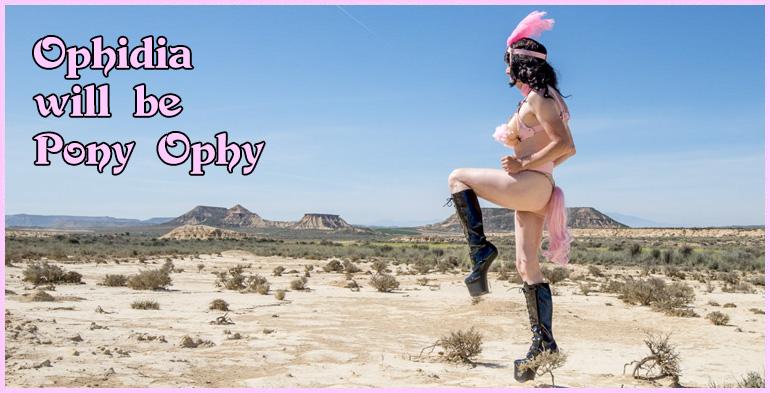
WARNING : There are several ways to practice Pony Play. Some practice on all fours, others actually ride the Pony. We have chosen ours. We will never claim that it is "the best" or "the only one", but it is the one that best suited our expectations and everything that follows therefore applies to this way of approaching the activity and should therefore not be seen as absolute rules that everyone should follow but rather as one of the existing versions of the activity!
Pony play is a game of domination between a trainer and a trained horse who learns various steps and must acquire good physical condition and certain reflexes. Everything is designed to resemble the training of an equine, hence the term 'Pony Play' and 'Pony Boy' or 'Pony Girl'. Summed up like this, this practice could be just another oddity in the varied world of fetish role-playing games, but there is something different here. At first, the "pony" analyzes each order and does what the order corresponds to, this is how the human brain works. But if the training is done regularly and seriously, there will come a time when the "pony" will realize that he has just obeyed without even realizing it. He no longer plays "Pony", he has become Pony... It is particularly disturbing the first few times, because it is truly a form of training, something that one may be led to do but very rarely to undergo.
In all "primitive" cultures, from North America to Eastern Europe, there are rituals of identification with an animal. Pony-play is therefore a practice apart from domination games because it calls upon very archaic anthropological constants. What happens must be experienced to be understood, but properly practiced, the activity induces a kind of trance for the 'Pony', a moment when the brain disconnects to access another level of reality, a primordial, shamanic reality. Of course, accessing this state requires prior training and real physical effort. Many practitioners are content to "play" Pony-Play without this goal in mind, but it is good to know that it exists.
Pony play is not a recent 'deviant' activity, as is often heard from those who are quick to criticize or mock without making the slightest effort to reflect. The Greek philosopher Aristotle is said to have loved to be ridden like a horse (In some circles, pony play is called "Aristotle's Perversion"). Further east, paintings dating from the Assyrian period have been found that undoubtedly depict pony play scenes. More recently, in the 19th century, pony play was a common erotic amusement among the wealthy classes in the British colonies.
n Pony-Play, the sexual dimension is secondary. Some trainers use their Pony in this sense, others organize sessions of mating of a Pony Girl by a Pony Boy but it remains really incidental. The only "sexual" act concerns the training of Pony Boys who must be 'drained' regularly to prevent them from mounting a Pony Girl but also to keep them very docile. This act is done coldly, medically, with a firm hand and the Pony Boy normally feels no pleasure from it (Any trace of visible satisfaction would result in a severe correction)
As agreed in the pedagogical approach of this site, I will gradually provide you with detailed descriptions of the exercises to be done. Furthermore, it is possible in the future that I will have to do these exercises with more intensity or in special outfits as punishment. These special sessions will be filmed and their public access will be part of my punishment.
Breaking in |
The concept of breaking in consists first of all in verifying that the future Pony has understood the basic rules arising from its status. In fact, the Pony accepts to have the status of an animal and no longer of a human. It therefore remains protected, like any animal, against sadistic mistreatment but loses certain rights specific to humans. |
| . | |
1st Whip |
Besides two new orders, the first riding crop mainly calls for work on endurance and regularity of steps. |
| . |
aaa
